TEA a HUG in a CUP Svg
As a designer who’s stitched hundreds of custom projects—from boutique baby onesies to holiday market tote bags—I opened the TEA a HUG in a CUP Svg file with quiet curiosity, not hype. I wasn’t looking for “cute.” I was asking: Will this hold up under needle and thread? Will it read clearly at 3 inches wide on a linen tea towel? Will my Etsy customers smile when they unbox it—and will they reorder?
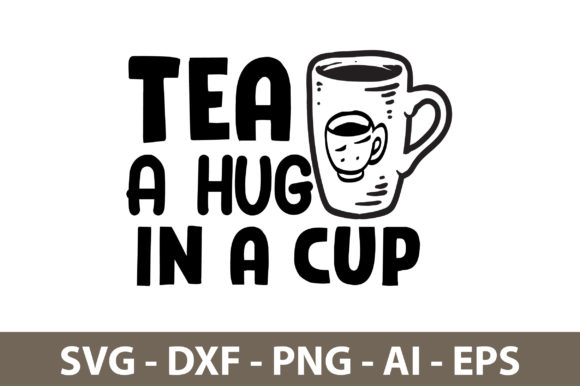
The first impression is warm, grounded, and intentionally unhurried. The cup sits centered, full but not overflowing, with steam curling like a gentle sigh. The phrase “a HUG in a CUP” wraps softly around the handle—not cramped, not sprawling—leaving breathing room for stitch definition. It’s not overly ornate, but it’s not minimalist either. There’s subtle weight in the letterforms, a slight rounded thickness that suggests satin stitch friendliness without demanding ultra-fine detail. That balance matters—especially if you’re stitching on textured fabrics like canvas totes or looped terry kitchen towels.
I tested TEA a HUG in a CUP Svg as a sweatshirt embroidery project: a relaxed-fit unisex crewneck for a local café’s staff gift line. On medium-weight fleece, with tear-away + cut-away stabilizer combo, the design stitched cleanly at 3.25”. The cup outline held crispness; the lowercase “a” and “u” in “HUG” didn’t collapse or blur. No floating stitches. No thread nesting in the curve of the handle. That tells me the vector paths are clean—not auto-traced, not oversimplified—and the spacing between letters respects real-world stitch behavior. For small business owners, that’s time saved on rehooping and troubleshooting.
This isn’t just a T-Shirt Designs graphic—it’s a mood anchor. It works beautifully on baby embroidery (think organic cotton burp cloths or knit caps), where softness and sincerity matter more than flash. It also lands well on holiday embroidery: embroidered pillow covers for cozy gifting, or personalized mugs wrapped in fabric sleeves. The theme invites warmth without leaning into cliché—no hearts, no glitter fonts, no forced whimsy. That authenticity builds trust, especially for handmade product buyers scrolling Etsy listings or browsing craft fair booths.
Where TEA a HUG in a CUP Svg shines brightest is in context-driven applications: aprons for bakeries, tea towel sets for wedding favors, or embroidered patches sewn onto denim jackets. Its moderate width-to-height ratio makes it forgiving on curved surfaces like caps—but I’d still recommend testing on scrap first. The lettering isn’t tiny, but the “g” tail and inner counter of the “a” are delicate enough that dense stitch density or low-quality thread could mute their shape on stretchy fabric or thin knits.
It’s worth noting: this is a Graphics file set—not an out-of-the-box machine embroidery design. You’ll need to digitize it yourself or work with a digitizer. That means stitch density, underlay strategy, and pull compensation are in your hands. If you’re using it for commercial embroidery, confirm whether your digitizing software handles the SVG cleanly—some struggle with overlapping paths in hand-drawn-style vectors. Always inspect the AI and EPS files side-by-side before digitizing; minor anchor point inconsistencies can cause gaps in satin borders.
For craft business owners, the versatility of the file formats is a real asset. The PNG works for printable mockups on Shopify or Etsy listings. The DXF imports cleanly into Wilcom or Pulse for precise placement on layered garments. And yes—it’s compatible with Cricut and Silhouette machines, which opens doors for hybrid projects: heat-transfer vinyl versions alongside embroidered runs, or iron-on patches paired with stitched totes.
But let’s talk caution zones. Avoid using TEA a HUG in a CUP Svg at under 2.5” on highly textured fabric like bouclé or heavy terry—those steam swirls and fine curves may lose definition. On dark fabric, test thread colors carefully: light cream or oatmeal thread reads softer than stark white, preserving the design’s gentle tone. And skip it entirely for ultra-thin fabrics like rayon challis unless you reinforce heavily—there’s enough visual weight here that skipped stitches would be immediately noticeable.
Here’s what I do before committing to any digital embroidery file—and why it matters for TEA a HUG in a CUP Svg:
- Test on scrap fabric—same weight, same weave, same wash history as your final product.
- Check thread color contrast on both light and dark backgrounds using actual thread spools, not screen previews.
- Review stitch density in your digitizing software—this design benefits from balanced fill stitch coverage, not aggressive density that causes puckering on knits.
- Confirm hoop size compatibility before prepping production—know your minimum working area.
- Inspect small details at 200% zoom: the steam tip, the inner bowl of the “a”, the curve where “CUP” meets the cup base.
- Test black-and-white mockups—if it reads clearly without color, your customers will recognize it instantly in photos.
- Use proper stabilizer—medium cut-away for knits, tear-away for stable wovens, and always float for caps or curved seams.
- Verify licensing before selling finished items or bundling the digital file—this is a digital download only, with no stated commercial license included.
Ultimately, TEA a HUG in a CUP Svg earns its place in a working designer’s library because it bridges sentiment and structure. It doesn’t shout. It settles in—like steam rising, like a pause mid-sentence, like the quiet pride in handing someone a perfectly embroidered gift. Whether you’re building a small shop product line, preparing for a holiday craft fair, or fulfilling a custom apparel order, this design supports intention over impulse. It reminds customers—and you—that handmade isn’t just about how something’s made. It’s about how it feels to receive it.